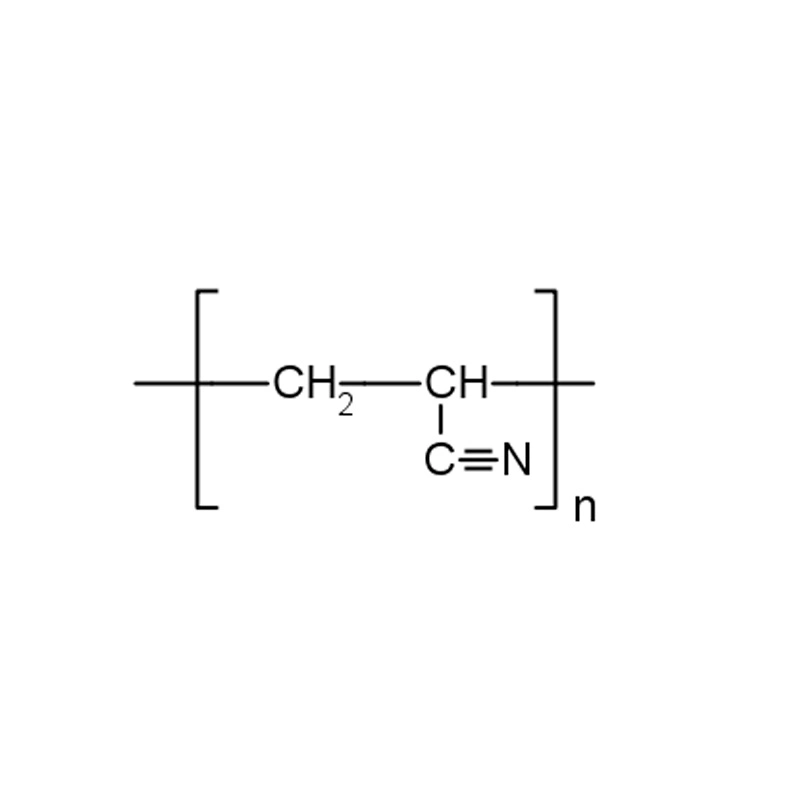
Products Description of Polyacrylonitrile CAS#25014-41-9
Polyacrylonitrile is a synthetic resin synthesized by free-radical polymerization of acrylonitrile, falling within the acrylic resin category. It is a thermoplastic material featuring outstanding resistance against most solvents and chemicals, which stems from the strong intermolecular bonding of nitrile groups. As a multi-purpose polymer, it is extensively applied to manufacture textile fibres, ultrafiltration membranes, carbon fibres and hollow-fibre reverse osmosis membranes. Its homopolymer can also be processed into outdoor awnings, yacht sails and fibre-reinforced concrete. Furthermore, it fits the production of inherently flame-retardant (FR) textiles.
Polyacrylonitrile Chemical Properties
Melting point | 317 °C |
Tg | 125 |
density | 1.184 g/mL at 25 °C (lit.) |
refractive index | n20/D 1.514 |
storage temp. | Sealed in dry,Room Temperature |
solubility | DMF (Slightly) |
form | Solid |
color | White to Off-White |
Stability: | Stable. Incompatible with strong oxidizing agents. |
InChI | InChI=1S/C3H3N/c1-2-3-4/h2H,1H2 |
InChIKey | NLHHRLWOUZZQLW-UHFFFAOYSA-N |
SMILES | C(#N)C=C |
EPA Substance Registry System | Polyacrylonitrile (25014-41-9) |
Safety Statements | 24/25 |
WGK Germany | 3 |
RTECS | AT6977900 |
TSCA | TSCA listed |
HS Code | 39069090 |
Hazardous Substances Data | 25014-41-9(Hazardous Substances Data) |
Toxicity | rat,LC,inhalation,> 25gm/m3 (25000mg/m3),Gigiena Truda i Professional'nye Zabolevaniya. Labor Hygiene and Occupational Diseases. Vol. 6(6), Pg. 54, 1962. |
Product Usage
Benefiting from its distinctive set of properties — UV-degradation resistance, low density, high tensile strength and elastic modulus, thermal stability, non-melting character and excellent chemical resistance — polyacrylonitrile represents a polymer of great significance with broad application scope.
Owing to its wool-like tactile properties, it enjoys extensive utilization within the textile sector. It also serves as feedstock for carbon fibres, filtration membranes, cement-reinforcing fibres, yacht sails and outdoor awning textiles. Beyond these uses, it is processed into speciality fibres for acoustic-thermal insulation, flame-retardant materials, and felts deployed in hot-air filtration systems.