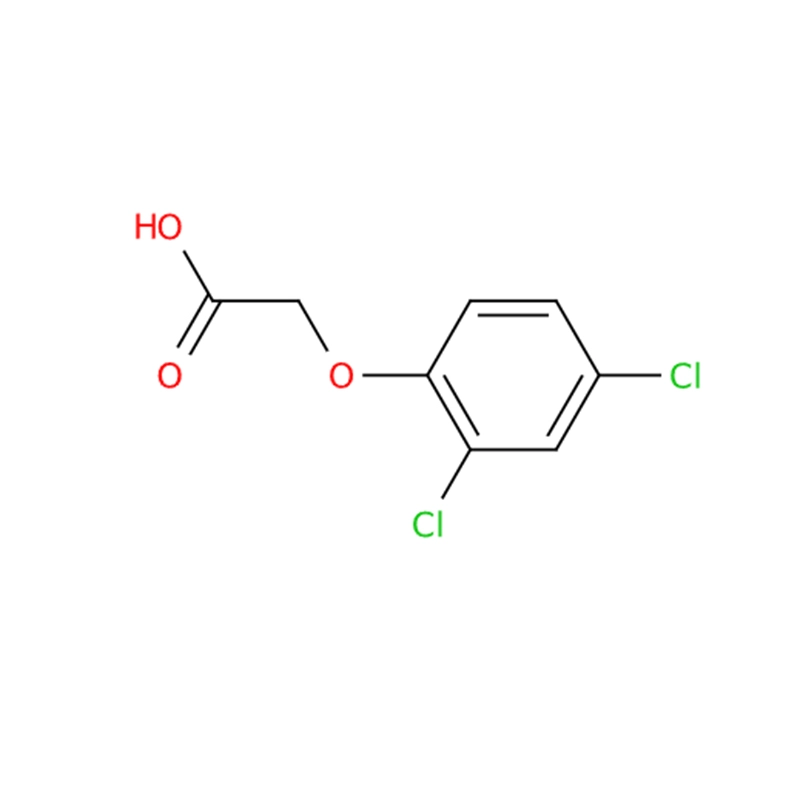
Product Description of 2,4-Dichlorophenoxyacetic Acid CAS#94-75-7
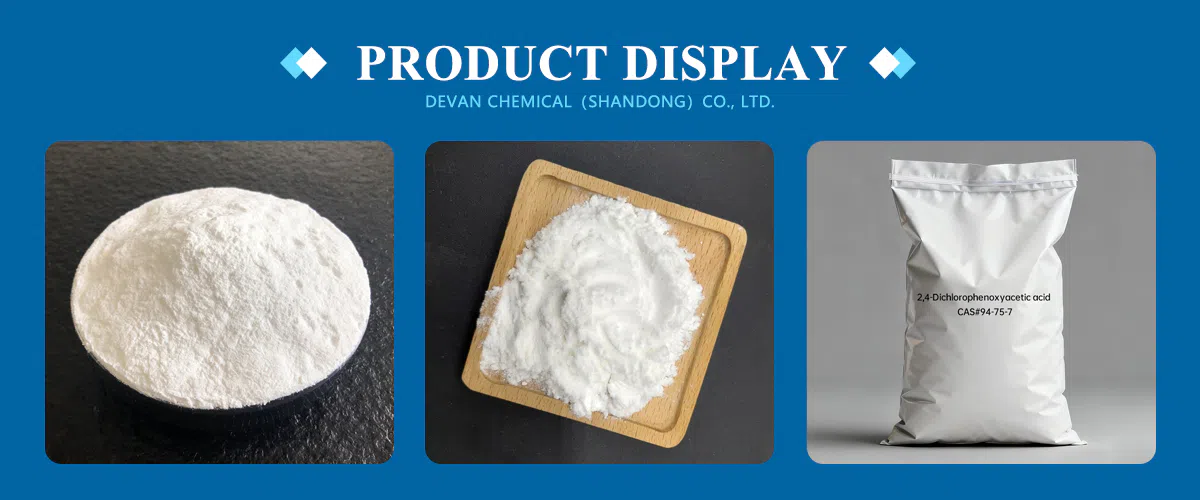
2,4-Dichlorophenoxyacetic Acid (CAS#94-75-7), also called 2,4-D, is a typical phenoxycarboxylic acid herbicide with molecular formula C8H6Cl2O3. It occurs as white to pale yellow crystalline powder, with a melting point of 136-140°C. This material is slightly soluble in water, while easily soluble in ethanol, ether and other organic solvents.
As a systemic auxin-type herbicide, it interferes with plant growth regulation and selectively kills broadleaf weeds. It is widely used in wheat, corn and rice fields for weed management.
2,4-Dichlorophenoxyacetic Acid Chemical Properties
| Melting point | 136-140 °C (lit.) |
| Boiling point | 160 °C (0.4 mmHg) |
| density | 1.563 |
| vapor pressure | 0.4 mm Hg ( 160 °C) |
| refractive index | 1.5000 (estimate) |
| Fp | 160°C/0.4mm |
| storage temp. | 2-8°C |
| solubility | Soluble in organic solvents (ethanol, acetone, dioxane) |
| pka | pK1:2.64 (25°C) |
| form | crystalline |
| color | White to pale yellow |
| PH Range | Acidic |
| Odor Threshold | 3.13 ppm |
| Water Solubility | Slightly soluble. Decomposes. 0.0890 g/100 mL |
| Merck | 142796 |
| BRN | 1214242 |
| Henry's Law Constant | 6.72 and 0.84 x 10⁻⁵ atm?m3/mol were reported at pH values of 1 and 7, respectively (wetted-wall column, Rice et al., 1997a) |
| Exposure limits | NIOSH REL: TWA 10 mg/m3, IDLH 100 mg/m3; OSHA PEL: TWA 10 mg/m3; ACGIH TLV: TWA 10 mg/m3. |
| Stability: | Stable, but moisture-sensitive and may be light-sensitive. Incompatible with strong oxidizing agents, corrodes many metals. Decomposes in water. |
| LogP | 2.81 |
| CAS DataBase Reference | 94-75-7(CAS DataBase Reference) |
| NIST Chemistry Reference | (2,4-Dichlorophenoxy)acetic acid(94-75-7) |
| IARC | 2B (Vol. 113) 2018 |
| EPA Substance Registry System | 2,4-D (94-75-7) |
| Hazard Codes | Xn,Xi,T,F |
| Risk Statements | 22-37-41-43-52/53-39/23/24/25-23/24/25-36/37/38-11-36-20/21/22-67-66 |
| Safety Statements | 24/25-26-36/37/39-46-61-2-45-36/37-27-16-7-9 |
| RIDADR | UN 3077 9/PG 3 |
| WGK Germany | 2 |
| RTECS | AG6825000 |
| Autoignition Temperature | > 180 °C |
| TSCA | Yes |
| HazardClass | 6.1 |
| PackingGroup | III |
| HS Code | 29189090 |
| Hazardous Substances Data | 94-75-7(Hazardous Substances Data) |
| Toxicity | LD50 (oral): rat [free] 375 mg/kg, [-Na] 666-805 mg/kg. |
| IDLA | 100 mg/m3 |
Product Application of 2,4-Dichlorophenoxyacetic Acid CAS#94-75-7
2,4-Dichlorophenoxyacetic Acid is a versatile fine chemical widely applied in agricultural and analytical fields. It is primarily utilized as an efficient herbicide and plant growth regulator for crop planting management. In organic microanalysis, it serves as a standard reference substance for carbon and hydrogen quantitative detection.
Furthermore, this compound can act as a preservative and be compounded with other disinfectants to enhance sterilization performance. It also exhibits certain inhibitory effects on citrus stem rot, providing auxiliary control for corresponding plant diseases in agricultural applications.