

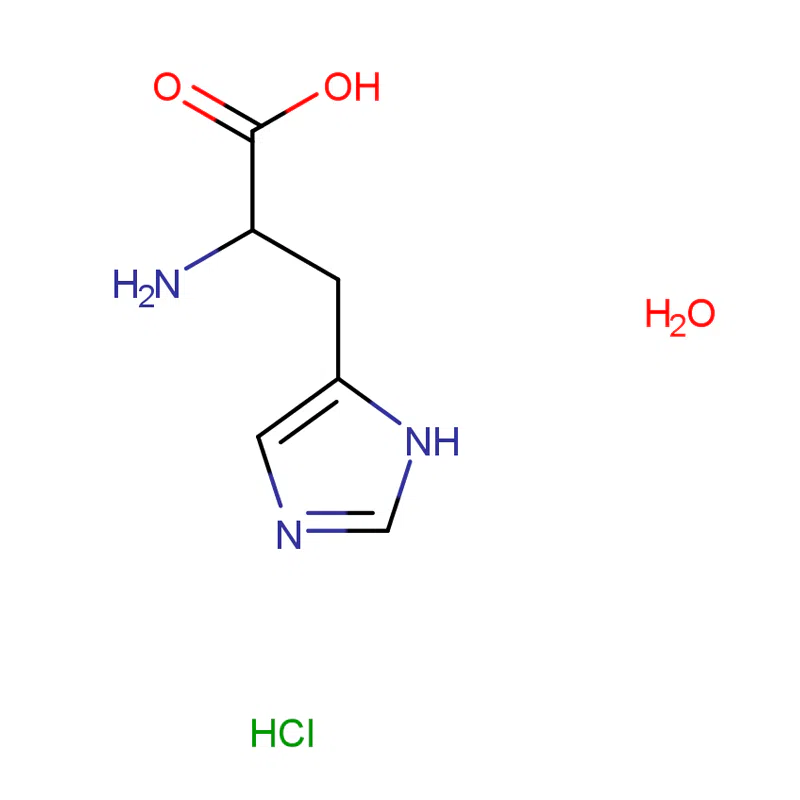
Products Description of L-Histidine Hydrochloride Monohydrate CAS#5934-29-2
L-Histidine Hydrochloride Monohydrate occurs as odorless white crystals or crystalline powder with a slightly acidic and bitter taste. The product remains stable under regular ambient conditions and melts with decomposition at about 250 ℃ after drying. Its aqueous solution presents acidic properties, with a pH value ranging from 3.5-4.5.
This compound features excellent water solubility, reaching approximately 39 g/100 mL at 24 ℃, which is much higher than pure L-histidine. It is insoluble in ethanol and ether solvents. L-histidine is a quasi-essential amino acid, and this hydrochloride salt supports infants and young children’s growth and development. The human body synthesizes L-histidine at a slow rate, and insufficient intake may lead to developmental retardation, eczema and other adverse symptoms.

L-Histidine Hydrochloride Monohydrate Chemical Properties
| Melting point | 254 °C (dec.)(lit.) |
| alpha | 9.9 º (c=11, 6 N HCl) |
| density | 1.49 g/cm3 |
| vapor pressure | <1 hPa (20 °C) |
| storage temp. | Store below +30°C. |
| solubility | H2O: 100 mg/mL |
| form | Solid |
| color | White |
| PH | 3.5-4.5 (100g/l, H2O, 20℃) |
| PH Range | 3 - 4 at 105 g/l at 25 °C |
| Odor | odorless |
| optical activity | [α]20/D +9.5±0.5°, c = 5% in 5 M HCl |
| Water Solubility | 169.9 g/L (20 ºC) |
| Merck | 144720 |
| BRN | 4168261 |
| InChIKey | CMXXUDSWGMGYLZ-XRIGFGBMSA-N |
| LogP | -3.32 at 25℃ |
| CAS DataBase Reference | 5934-29-2(CAS DataBase Reference) |
| Hazard Codes | Xn |
| Risk Statements | 22-36/37/38 |
| Safety Statements | 22-24/25-36/37-26 |
| WGK Germany | 3 |
| RTECS | MS3119000 |
| F | 10 |
| TSCA | Yes |
| HS Code | 29332990 |

Product Application of L-Histidine Hydrochloride Monohydrate CAS#5934-29-2
L-Histidine Hydrochloride Monohydrate is widely applied as a high value nutritional supplement. L-histidine is a semi-essential amino acid with slow synthesis in the human body, and this hydrochloride salt is commonly incorporated into infant formulas and postoperative nutritional products to supplement amino acid intake and improve overall nutritional status.
In the food processing industry, this compound serves as a flavor modifier. When combined with leucine and arginine in bread production using chemical leavening agents, it effectively optimizes the product’s flavor and improves the overall taste quality of baked goods.