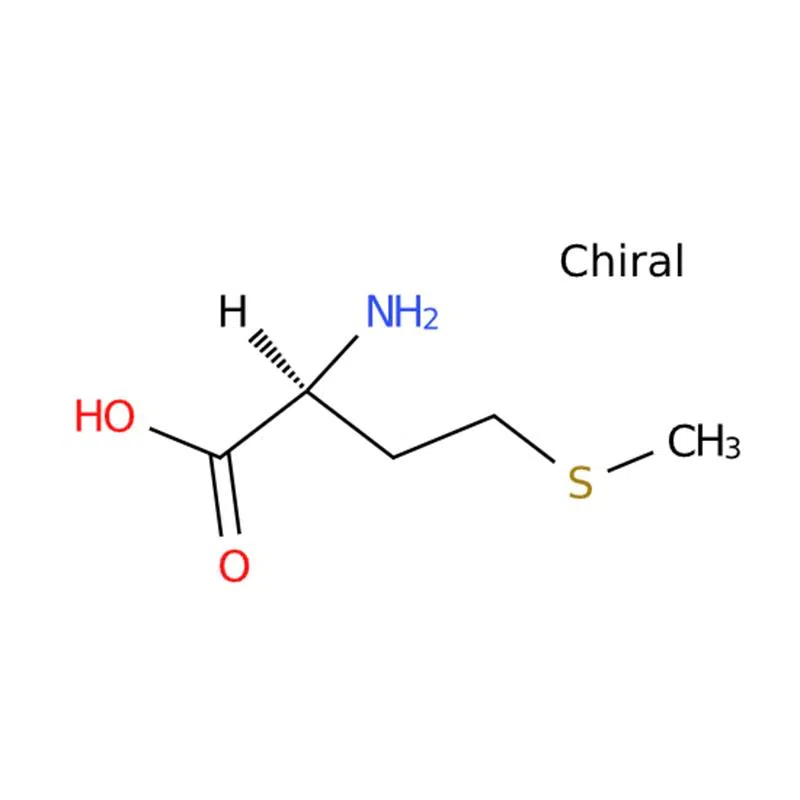
Product Description of L-Methionine CAS#63-68-3
Methionine is a sulfur-bearing essential L-amino acid that participates in a wide range of critical physiological processes. As an indispensable nutrient amino acid, it supports the normal growth and developmental metabolism of humans, mammals and poultry. Apart from acting as a fundamental building block for protein synthesis, it also serves as a key intermediate in transmethylation reactions and works as a major methyl group provider in biological metabolism.
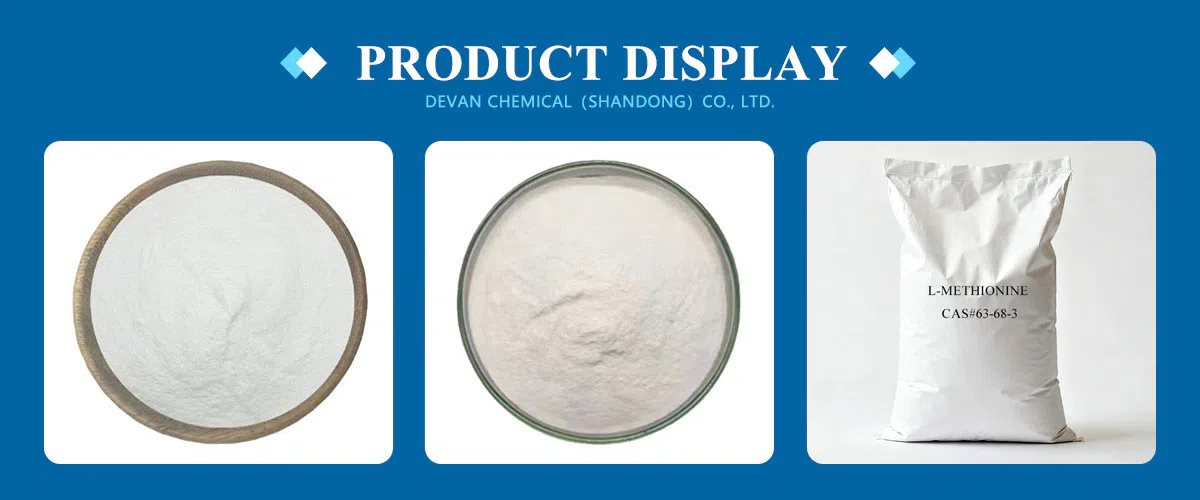
L-Methionine Chemical Properties
| Melting point | 284 °C (dec.)(lit.) |
| alpha | 23.25 º (c=2, 6N HCl) |
| Boiling point | 393.91°C (estimate) |
| density | 1,34g/cm |
| bulk density | 550kg/m3 |
| refractive index | 1.5216 (estimate) |
| storage temp. | 20-25°C |
| solubility | 1 M HCl: 0.5 M at 20 °C, clear, colorless |
| pka | 2.13(at 25℃) |
| form | Solid |
| color | White |
| Odor | Slight characteristic |
| PH | 5-7 (10g/l, H2O, 20℃) |
| biological source | synthetic |
| Optical Rotation | [α]20/D +23.7±0.5°, c = 5% in 5 M HCl |
| Water Solubility | Soluble |
| λmax | λ: 260 nm Amax: 0.40 |
| λ: 280 nm Amax: 0.05 | |
| Merck | 145975 |
| BRN | 1722294 |
| Stability: | Stable. Incompatible with strong oxidizing agents. |
| LogP | 0.217 (est) |
| CAS DataBase Reference | 63-68-3(CAS DataBase Reference) |
| NIST Chemistry Reference | L-Methionine(63-68-3) |
| EPA Substance Registry System | L-Methionine (63-68-3) |
Safety Information
| Risk Statements | 33 |
| Safety Statements | 24/25 |
| WGK Germany | 2 |
| RTECS | PD0457000 |
| F | 46318 |
| TSCA | Yes |
| HS Code | 29304010 |
| Hazardous Substances Data | 63-68-3(Hazardous Substances Data) |
| Toxicity | LD50 oral in rat: 36gm/kg |

Product Application of L-Methionine CAS#63-68-3
L-Methionine is commonly formulated into amino acid medicines and nutritional supplements, and it is clinically applied to assist the treatment of fatty liver and liver cirrhosis. In addition, it is extensively adopted as a high-efficiency feed additive to improve feed quality, elevate the utilization rate of natural protein sources, and accelerate animal growth performance. To be specific, methionine supplementation can effectively boost the egg production rate of laying hens, promote weight gain of pigs, and increase the milk output of dairy cows.