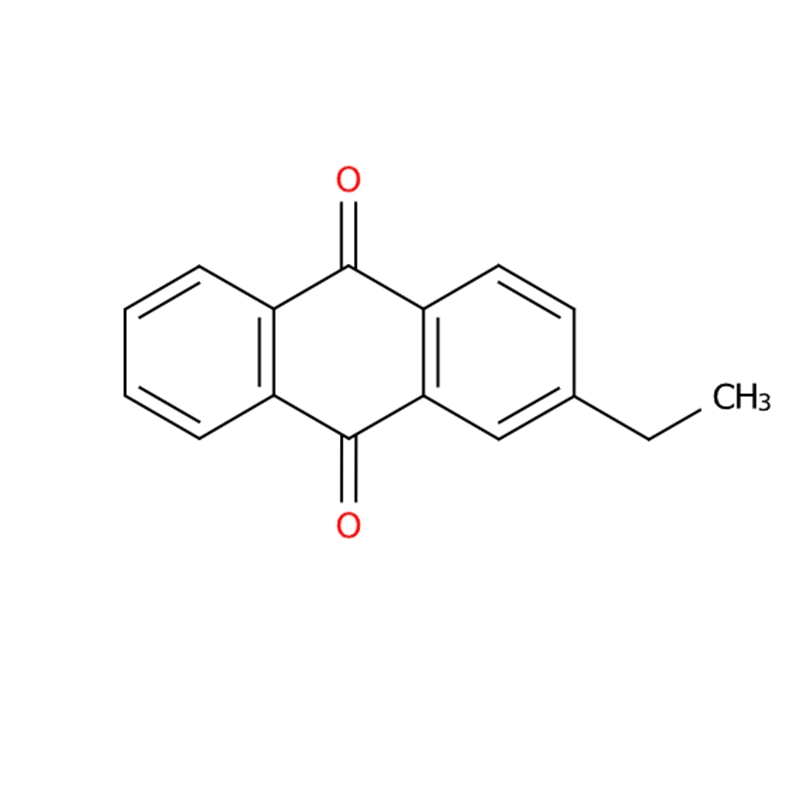
Products Description of 2-Ethyl Anthraquinone CAS#84-51-5
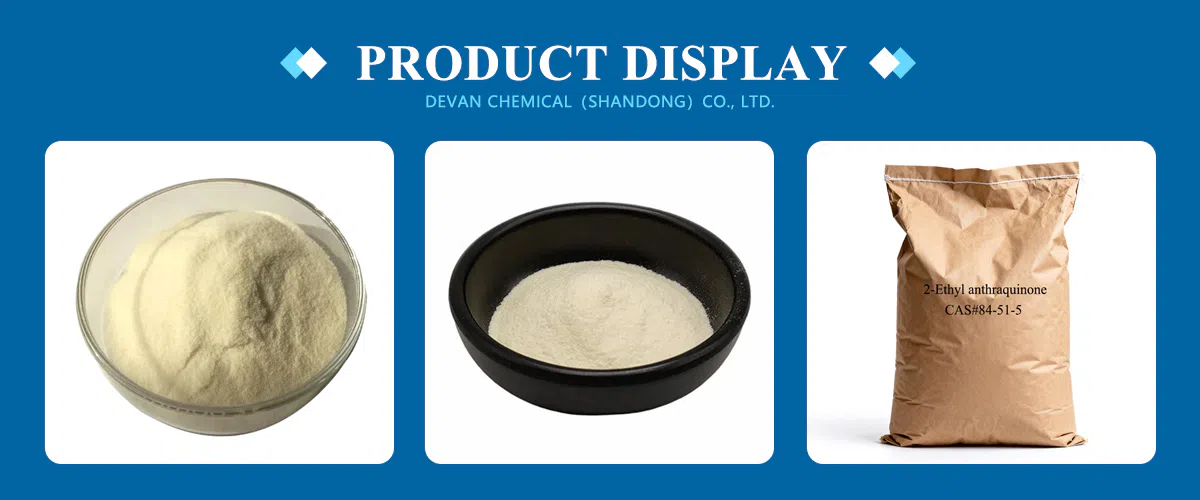
2-Ethyl anthraquinone is an aromatic anthraquinone compound with molecular formula C₁₆H₁₂O₂ and molecular weight 236.27. It appears as pale yellow crystalline powder. This substance is slightly soluble in water, soluble in ethanol, benzene, toluene and other organic solvents. It has stable chemical properties under normal storage conditions and can be reduced and oxidized reversibly.
It is the key working carrier in the industrial hydrogen peroxide production process. High-purity grades are also applied for the synthesis of fine chemicals and dyestuff intermediates.
2-Ethyl Anthraquinone Chemical Properties
| Melting point | 108-111 °C (lit.) |
| Boiling point | 180-190°C |
| density | 1.27 g/cm3 (21℃) |
| vapor pressure | <1 hPa (25 °C) |
| refractive index | 1.6290 (estimate) |
| Fp | >210°C |
| storage temp. | Store below +30°C. |
| solubility | 0.00025g/l |
| form | powder to crystal |
| color | Light yellow to Amber to Dark green |
| Water Solubility | Insoluble in water. |
| BRN | 1969873 |
| Stability: | Stable. Combustible. Incompatible with strong oxidizing agents. |
| InChIKey | SJEBAWHUJDUKQK-UHFFFAOYSA-N |
| LogP | 4.6 |
| CAS DataBase Reference | 84-51-5(CAS DataBase Reference) |
| NIST Chemistry Reference | 9,10-Anthracenedione, 2-ethyl-(84-51-5) |
| EPA Substance Registry System | 2-Ethylanthraquinone (84-51-5) |
Safety Information
| Hazard Codes | Xn,N |
| Risk Statements | 22-36/37/38-50/53-48/22 |
| Safety Statements | 24/25-36-26-61-60-37 |
| RIDADR | UN 3077 9 / PGIII |
| WGK Germany | 1 |
| RTECS | CB0525000 |
| Autoignition Temperature | 485 °C |
| TSCA | Yes |
| HS Code | 29146990 |
| Toxicity | LD50 orally in Rabbit: > 6400 mg/kg |
Product Application of 2-Ethyl Anthraquinone CAS#84-51-5
2-Ethylanthraquinone undergoes hydrogenation in solvent to yield 2-ethylhydroanthraquinone. The intermediate is then reoxidized, regenerating 2-ethylanthraquinone while generating hydrogen peroxide. This industrial route is extensively adopted for hydrogen peroxide production.
It may be synthesized by the Friedel–Crafts reaction between phthalic anhydride and ethylbenzene. An alternative preparation method relies on Diels–Alder cycloaddition of 1,4-naphthoquinone with 2-ethyl-1,3-butadiene, followed by dehydrogenation.
Apart from its core application in hydrogen peroxide manufacturing, the compound acts as an intermediate for dye synthesis. It can also function as a photosensitizer for photosensitive resins, a catalyst for photocurable resins, an ingredient in photodegradable films and coatings, as well as a photopolymerization initiator.